

How to Start Intermittent Fasting

Key takeaways
- Start with a 12-hour overnight fast before testing longer windows.
- Judge the plan by repeatability, sleep, energy, and hunger, not by how hard it feels.
- If the schedule clashes with work, family, training, or medication timing, change the window before forcing it.
- Use the first week to collect patterns, then repeat, extend slightly, or pause.
Most beginners do not need a harder fasting plan. They need one they can repeat next Tuesday.
That usually means starting with a normal overnight gap, keeping it steady for a week or two, and only then deciding whether a longer window is worth it. Jumping straight to 16:8 can work for some people, but it is not the default starting point for everyone.
The beginner pattern across the research is not complicated: pick a schedule you can repeat, keep meals and sleep reasonably steady, and treat discomfort as feedback instead of proof that the plan is working.
If you are pregnant, have a history of disordered eating, take medication affected by food timing, manage diabetes, or have a medical condition, talk with a qualified clinician before starting.
Start with 12 hours before chasing 16:8
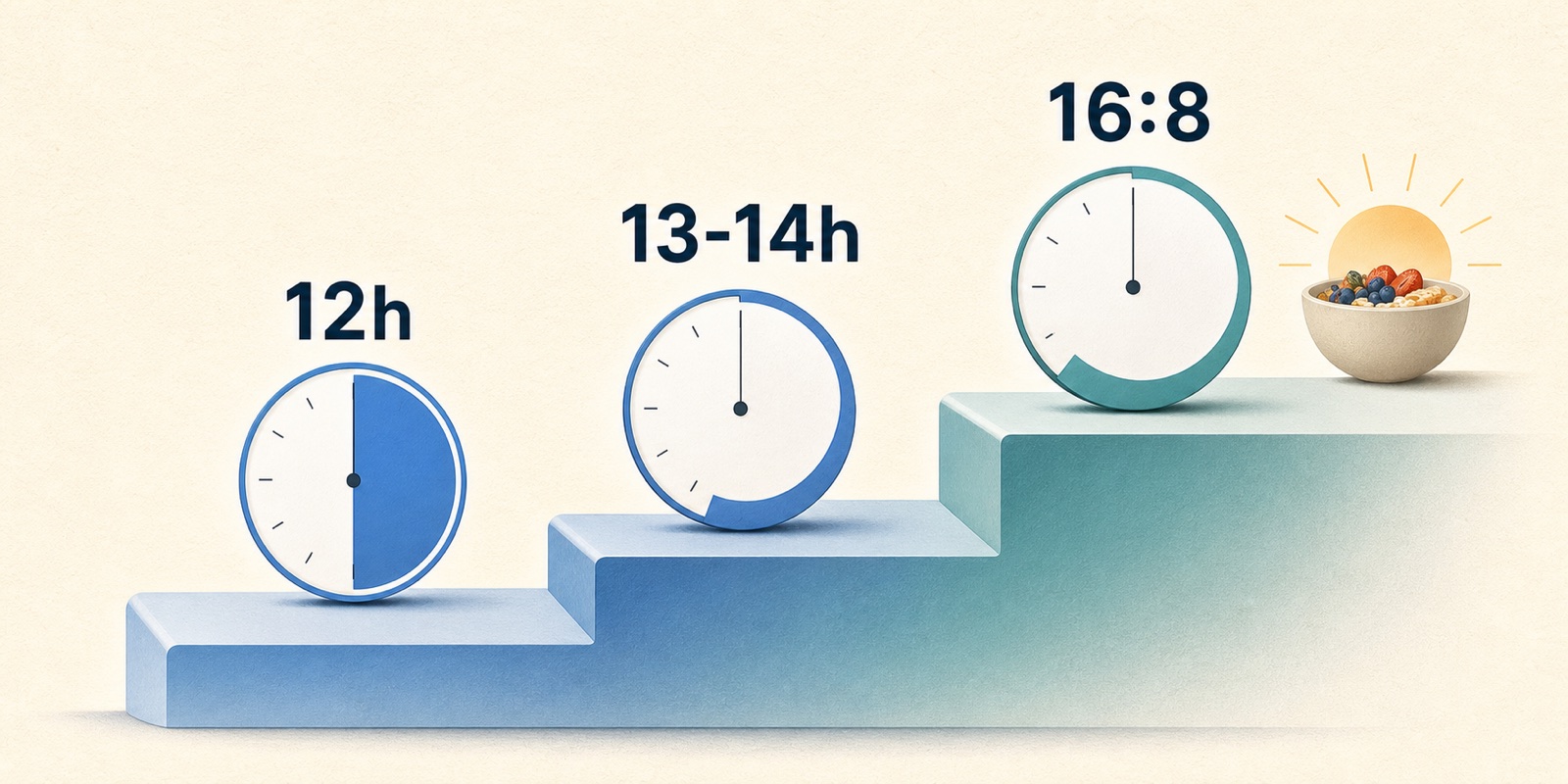
A common first step is a 12-hour overnight fast. For example, finish dinner at 7 p.m. and eat breakfast after 7 a.m. This gives you a clear boundary without changing your whole day.
If that feels normal after a week or two, try 13 or 14 hours. If that still feels repeatable, then a 16:8 rhythm may be worth testing.
This staged approach is boring in the best way. Reviews of intermittent fasting cover multiple protocols, including time-restricted eating, alternate-day fasting, 5:2 fasting, and longer fasts, but they do not turn “harder” into “better” for a beginner (Attina, Mingione, Leggeri et al., 2021, de Cabo and Mattson, 2019).
Pick a fasting window that fits your real life
The hard part is not choosing a protocol on paper. It is fitting the schedule into work, family meals, training, sleep, and social life.
A qualitative study on time-restricted eating looked at what helped and hurt adherence. The practical takeaway is simple: people do better when the eating window fits their daily routine and social context (O’Connor, Bailey, Boyd et al., 2022).
For most beginners, that means:
- Keep dinner and breakfast timing predictable before shortening the window.
- Avoid starting with a plan that fights your work schedule every day.
- Notice which days feel easy, not just which days look perfect in a tracker.
- Treat weekends as part of the plan instead of pretending they do not exist.
Track the rhythm, not just the streak
Streaks can be motivating, but they can also make a missed day feel bigger than it is. A better early signal is whether your routine is becoming easier to repeat.
Use your first week of tracking to answer practical questions:
- What time do I usually start and stop?
- Which days feel easiest?
- Which meals make the next fast more comfortable?
- Do late nights make the next morning harder?
The more honest the log is, the more useful it becomes. That is where Fastology helps: it gives you a clean timer, Apple Watch access, and history you can actually scan later.
Keep meals, sleep, and hydration steady
Hydration, sleep, and balanced meals matter. Fasting does not cancel out the need for enough protein, fiber, and overall nutrition during your eating window.
A review on fasting diets and eating behaviors, sleep, mood, and well-being makes this point clearly enough: fasting is not just a timer. It interacts with normal daily behaviors, including how people eat, sleep, and feel (Ammar, Gibson, Hosseini, Trabelsi et al., 2024).
If a schedule makes you feel lightheaded, unusually fatigued, irritable, or preoccupied with food, shorten the fast and reassess. Consistency should not require ignoring clear feedback from your body.
Do not use weight loss as the only signal
Weight may change slowly, unevenly, or not at all at first. It can also move for reasons that have nothing to do with fat loss.
Meta-analyses and umbrella reviews suggest intermittent fasting can help some people with weight and cardiometabolic outcomes, but the effect depends on the protocol, the person, and what happens during eating windows (Ni, Lou et al., 2022, Zou, Zhang et al., 2024).
For the first two weeks, better signals are practical:
- Did I complete the window without feeling wrecked?
- Did I sleep normally?
- Did I eat normal meals instead of compensating later?
- Did this feel easier by the end of the week?
A simple first-week intermittent fasting plan
Try this if you want a low-pressure start:
| Step | What to do | What to watch |
|---|---|---|
| Days 1-3 | Try a 12-hour overnight fast. | Notice sleep, hunger, energy, and whether the schedule feels realistic. |
| Days 4-6 | Keep the same start time on most nights. | Look for patterns instead of chasing a perfect streak. |
| Day 7 | Review your logs before changing the window. | Repeat 12 hours, move to 13 or 14 hours, or pause if it feels like a poor fit. |
That last option matters. A plan that makes you feel worse is information, not failure.
What to do after your first week
If 12 hours feels calm and repeatable, stay there for another week or test 13 or 14 hours. If it feels rough, keep the window where it is or pause and reassess. Beginners do not need to earn the right to keep things simple.
If you are still deciding whether the routine is worth trying at all, read What Are the Benefits of Intermittent Fasting?. That article covers the main upsides people look for, along with the limits and tradeoffs.
Where Fastology fits
Fastology is built for the part that usually decides whether fasting is useful: consistency. You can start a fast quickly, check progress from iPhone or Apple Watch, and review history later to see whether the routine is becoming easier to repeat.
The best beginner plan is usually the one you do not have to constantly negotiate with yourself. Start simple, track honestly, and let the pattern become visible.
References
- Attina, Mingione, Leggeri et al., 2021. Fasting: How to Guide
- de Cabo and Mattson, 2019. Effects of Intermittent Fasting on Health, Aging, and Disease
- O’Connor, Bailey, Boyd et al., 2022. A qualitative exploration of facilitators and barriers of adherence to time-restricted eating
- Ammar, Gibson, Hosseini, Trabelsi et al., 2024. Fasting diets: what are the impacts on eating behaviors, sleep, mood, and well-being?
- Ni, Lou et al., 2022. IF in Human vs. Caloric Restriction: Meta-Analysis of RCTs
- Zou, Zhang et al., 2024. Intermittent fasting and health outcomes: umbrella review of systematic reviews and RCTs