

12:12 vs 14:10 vs 16:8

Key takeaways
- 12:12 is the easiest entry point and often the best place to start.
- 14:10 can add structure without making the day feel rigid.
- 16:8 works for some people, but it is not automatically the best beginner plan.
These three schedules get talked about as if they are steps on the same ladder.
Sometimes they are. Often they are just different tools with different amounts of friction.
If you only need the short answer, it is this:
12:12is usually the easiest place to start.14:10is often the most balanced middle ground.16:8can work well, but it asks more from your day.
That is the practical answer because schedule choice is less about fasting identity and more about whether the plan holds up when your week is busy, social, or imperfect.
Research on intermittent fasting supports several protocols rather than one universally superior daily window, and real-world adherence depends heavily on routine fit, hunger, work timing, social life, and exercise timing (Semnani-Azad, Khan, Sievenpiper et al., 2025, O’Connor, Bailey, Boyd et al., 2022).
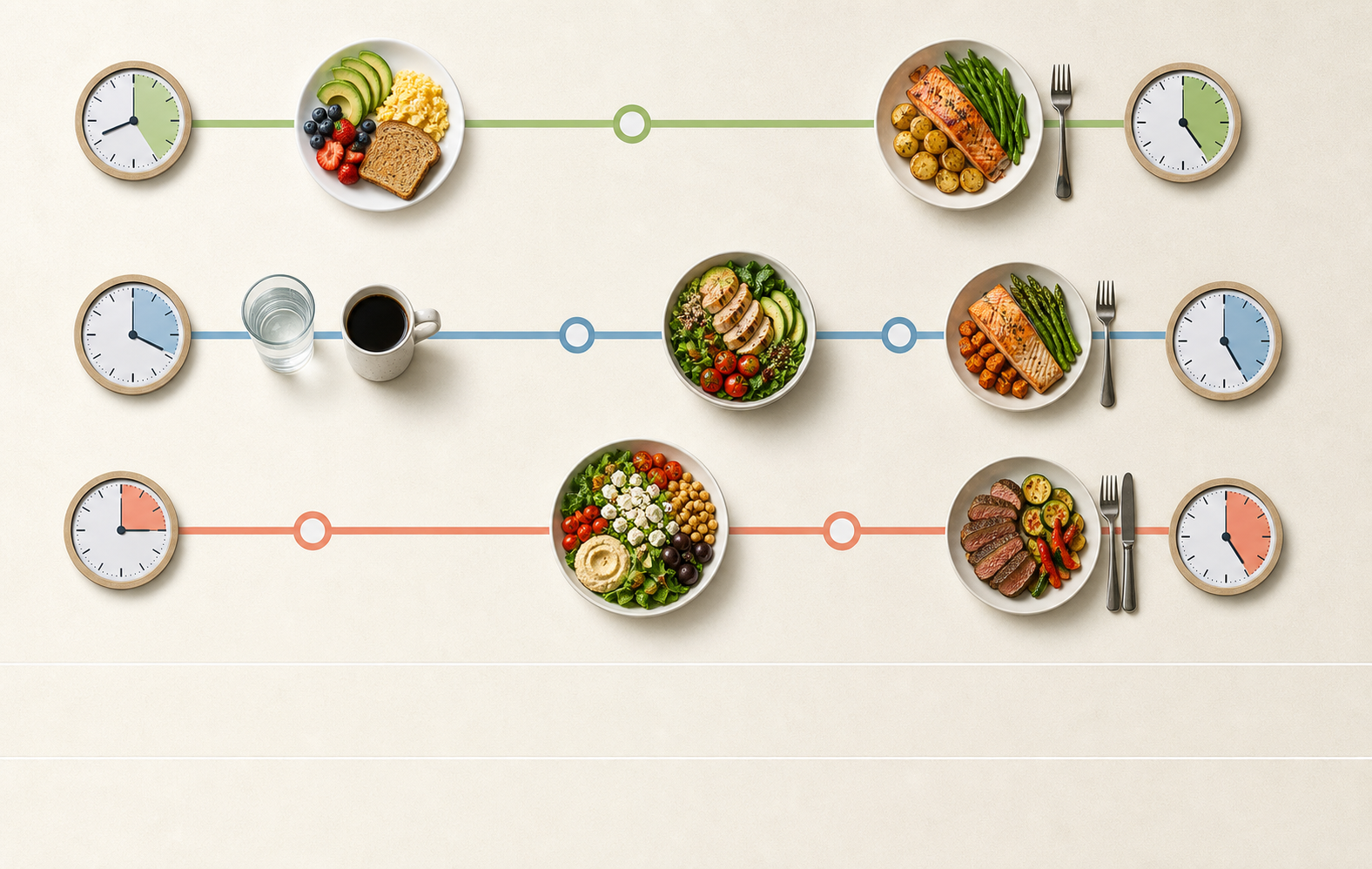
What each schedule actually feels like
The simplest way to compare these windows is to ask what part of the day each one changes.
12:12
This is the lightest structure.
Example: finish dinner at 7 p.m., eat breakfast at 7 a.m.
For many people, this feels close to normal life. That is why it is often underrated. It can reduce late-night snacking, create a clean overnight boundary, and teach consistency without forcing a major social or work adjustment.
The main downside is that some people are already doing something close to this. If your natural pattern already includes a 12-hour overnight gap, it may not feel like much of a change.
14:10
This is usually the middle-ground schedule.
Example: finish dinner at 7 p.m., eat breakfast at 9 a.m.
It creates more noticeable structure than 12:12, but it still leaves room for breakfast and dinner in a fairly normal day. For many beginners, this is the first window that feels intentional without feeling rigid.
The main challenge is that it can expose weak points fast. If your mornings are hectic, if you train early, or if you are already stretched on sleep, those extra two hours can feel bigger than they sound.
16:8
This is the most recognizable schedule and the one most beginners hear about first.
Example: finish dinner at 8 p.m., eat first meal at noon.
For some people, especially those who never liked early breakfast anyway, 16:8 feels clean and simple. For others, it adds too much friction too quickly. Morning hunger, social breakfasts, childcare, commute schedules, medication timing, and training can all become bigger issues here.
That does not make 16:8 bad. It just makes it less automatic than fasting content often suggests.
The real comparison is friction
Here is the comparison that matters most:
| Schedule | Difficulty | Flexibility | Hunger risk | Social fit | Best use |
|---|---|---|---|---|---|
12:12 | Lowest | High | Lowest | High | First step, late-night snacking control |
14:10 | Moderate | Good | Moderate | Good | Beginners who want more structure |
16:8 | Highest of the three | Moderate | Higher for many people | Mixed | People who already tolerate later first meals |
That pattern lines up with what adherence research tends to show. People do not struggle with fasting only because they lack discipline. They struggle because schedules collide with family meals, weekends, exercise timing, low energy, or uncomfortable hunger (O’Connor, Bailey, Boyd et al., 2022).
And when researchers compared several fasting approaches in a pilot feasibility crossover study, standard time-restricted feeding was rated easier to follow than early time-restricted feeding or alternate-day fasting, while alternate-day fasting was rated hardest (Turner-McGrievy, Wirth, Bernhart, Aydin, 2022). Again, that does not prove 16:8 beats 12:12 or 14:10. It does reinforce the bigger point: a daily rhythm that fits your life usually has a better chance than a more aggressive pattern that constantly needs rescue.
Which one should most beginners choose
For most beginners:
- Choose
12:12if you want the safest entry point. - Choose
14:10if 12 hours already feels normal and you want a little more structure. - Choose
16:8only if delayed first meals already feel natural and your schedule supports them.
This is where a lot of people overreach. They treat 16:8 like the real version of intermittent fasting and the shorter windows like a warm-up. That mindset is usually what creates the first unnecessary failure.
You are not trying to impress the schedule. You are trying to build a routine.
When to move up and when to step back
Move from one window to the next only if the current one feels stable for at least a week or two.
Good reasons to move up:
- the current window feels easy
- your sleep is fine
- you are not obsessing about the clock
- meals still fit your real day
Good reasons to stay where you are or step back:
- you feel low-energy most mornings
- workouts feel noticeably worse
- you are overeating later because the window feels too restrictive
- weekends or family meals keep blowing up the plan
A 2025 meta-analysis reported higher hunger in time-restricted eating interventions among adults with overweight or obesity in included randomized studies (Silva, Guimarães, Oliveira et al., 2025). That is useful because it reframes hunger. More hunger does not mean the schedule is superior. It may simply mean the current window is not the best fit for you yet.
The best schedule is the one you can repeat next week
That is the whole decision framework.
If you want the full beginner decision guide, read Best Intermittent Fasting Schedule for Beginners. If you are brand new to fasting in general, How to Start Intermittent Fasting is the better first read.
Safety note
If you are pregnant, under 18, have a history of disordered eating, manage diabetes, take medication tied to meal timing, or have another medical reason not to delay food, get clinician guidance before trying any fasting schedule. If a schedule repeatedly causes dizziness, intense fatigue, or loss of control around food later in the day, stop and shorten the window instead of pushing through it.
References
- Semnani-Azad, Khan, Sievenpiper et al., 2025. Intermittent fasting strategies and cardiometabolic outcomes: network meta-analysis of RCTs
- O’Connor, Bailey, Boyd et al., 2022. A qualitative exploration of facilitators and barriers of adherence to time-restricted eating
- Turner-McGrievy, Wirth, Bernhart, Aydin, 2022. The Fasting and Shifted Timing (FAST) of Eating Study: A pilot feasibility randomized crossover intervention assessing the acceptability of three different fasting diet approaches
- Silva, Guimarães, Oliveira et al., 2025. Time-restricted eating increases hunger in adults with overweight and obesity: A systematic review and meta-analysis of randomized controlled studies